For healthcare
The patient may arrive anywhere. The obligation follows.
Effective communication is not limited to the hospital. Federal accessibility obligations extend across the healthcare experience — from an unplanned emergency visit to a scheduled dental appointment.

Different facilities operate differently. The responsibility to communicate does not disappear with scale.
ADA Title II
Public hospitals, county clinics, and state or local healthcare facilities.
ADA Title III
Private healthcare providers and places of public accommodation, including hospitals, physicians, and dental offices.
Section 504 / Section 1557
Additional federal nondiscrimination and effective-communication obligations for many organizations receiving federal financial assistance.
A communication obligation without reliable access is still an unresolved obligation.
Neither is the enforcement.
Regulators continue to enforce effective-communication obligations across healthcare settings. The cases below are real.
Recent enforcement examples · U.S. Department of Justice
$4.25M
Settlement · May 2023
Tenet Healthcare Corporation
Resolved allegations that the hospital system failed to provide qualified sign language interpreters for patients who are deaf, including in emergency department settings.
$2.2M
Settlement · August 2016
HCA Healthcare, Inc.
Resolved allegations of failing to provide qualified interpreters across multiple hospitals to patients who are deaf.
$1.15M
Settlement · July 2014
Envision Healthcare Corporation
Resolved allegations that the company failed to provide qualified interpreters for deaf patients in its emergency departments.
Obligations are enforceable. And the standard is clear.
“The patient arrives now. The interpreter may not.”
Healthcare operates 24/7. Qualified human interpreters are finite. Need does not follow a schedule.
24/7 need
Patients need communication every hour of every day.
Finite capacity
The pool of qualified, certified interpreters is limited in every market.
Long ramp
Certification and training take years. Capacity grows slowly.
Unplanned care
Emergencies, walk-ins, admissions, and surges do not follow business hours.
VRI depends on humans
Video remote interpreting still requires a human to be available.
This is not a failure of interpreters. It is a limit of human availability.
The spending already exists. The reliability does not.
Interpreter coverage is already a budget line. So are connection delays, lost staff time, and the operational cost of arranging, waiting, documenting, rescheduling, and escalating.
Urgent · Behavioral · Outpatient
$432,000+
One facility documented more than $432,000 in annual ASL/VRI-related cost, including substantial nursing time lost to connection delays.
Hospital / Health system
Millions / year
Carolinas Healthcare reported interpreter spending in the millions annually, even after shifting significant volume to VRI.
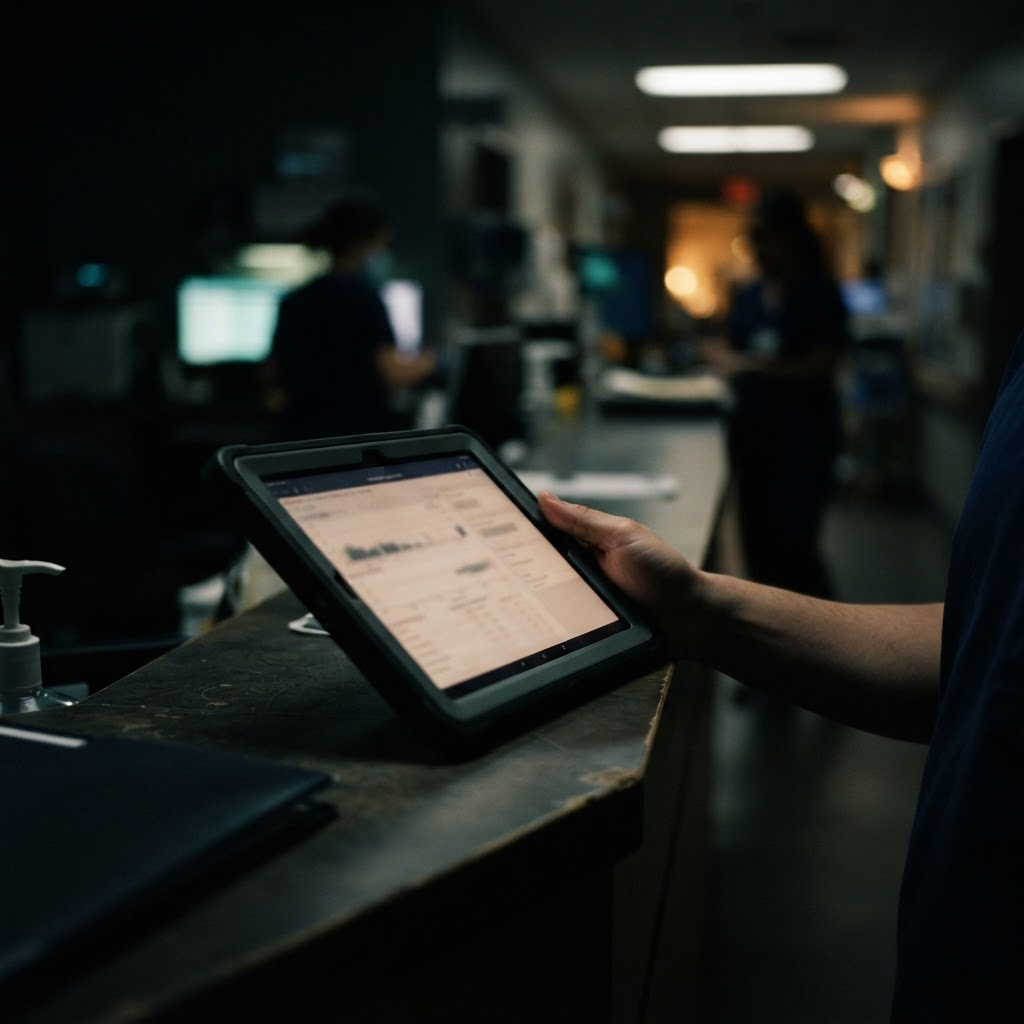
The most expensive communication system is the one you pay for twice: once to provide it, and again when it fails.
You are not creating a new expense. You are redesigning an existing one.
The spending already exists. bitsign is designed to change the economics.
Healthcare organizations are already paying millions for communication that is unavailable, delayed, or inconsistent. bitsign is designed to expand communication availability while reducing the structural cost of delivering it. The figures below are internal cost models, not measured customer outcomes.
Modeled — typical
~1/10 the cost
Of conventional interpretation in our internal deployment models.
Modeled — high utilization
~1/50 the cost
In high-utilization environments, based on our current internal cost modeling.
Not lower-quality communication — a lower-cost way to make communication available.
Actual savings vary by utilization, facility type, interpreter mix, and deployment configuration.
Illustrative annual cost model
Illustrative model based on stated assumptions — mid-size hospital system, 1,000 ASL encounters per year.
Conventional interpreter model
$1,250,000
In-person, video, and on-demand services.
bitsign model
$125,000
Real-time AI communication platform.
Estimated annual savings
$1,125,000
90% less
Where the cost difference comes from
Designed to expand communication availability while reducing structural delivery costs — by removing the inefficiencies that make communication so expensive today.
Wider availability. Lower structural cost.
“Care begins when two people understand each other.”
A patient signs. bitsign renders meaning as speech. The clinician speaks. bitsign returns the response.
Real-time, bidirectional translation between signing and speech — through captions and signing. No scheduling. No queue. No new hardware.
Immediate
Available at triage, bedside, exam room, or pharmacy counter. No scheduling. No queue. No new hardware.
Bidirectional
Signing to speech. Speech back to signing. In real time.
Always available
Built for the unscheduled arrival, the overnight shift, and the moment human capacity isn't available.
Designed to operate alongside qualified interpreters and established accommodation processes, not indiscriminately replace them.
The conversation belongs to the patient. Not to us.
Healthcare communication can contain some of the most private information a person will ever share. bitsign is being engineered around that reality from the beginning.
Protected in use
Confidential inference is designed to process communication inside hardware-isolated trusted execution environments, protecting information while computation occurs.
Minimum necessary
bitsign is designed to translate the interaction, not create a patient profile. Identity and clinical data are separated from the translation layer wherever they are not required.
Controlled by the facility
BAA-governed deployment, encrypted handling, access controls, audit logging, retention controls, and enterprise device management are built into the clinical architecture.
Privacy should not depend on a promise. It should be built into the system.
Meaning is more than a sign.
A signed conversation carries information through the hands — but also through facial expression, posture, movement, timing, intensity, and context. bitsign is being built to understand the whole person.
Hands
Shape · Position · Movement
Face
Expression · Gaze · Mouth movement
Body
Posture · Orientation · Intensity
Time
Sequence · Rhythm · Duration
The goal is not to recognize motion. It is to understand what a person means.
Not another workflow. Part of the one you already have.
Arrival
Walk-ins · Registration
Triage
Symptoms · History · Urgency
Care
Examination · Treatment · Consent
Discharge
Instructions · Medication · Follow-up
bitsign available throughout
Works alongside your process
Designed to support communication while qualified interpreter services and individualized accommodation decisions remain available where required.
Uses existing devices
Facility-controlled phones and tablets. No dedicated communication cart. No specialized room. No separate physical infrastructure.
Creates the access record
Availability, activation, duration, use, and escalation can be documented contemporaneously — without turning the communication itself into a patient surveillance product.
Care moves from room to room. Understanding should move with it.
“Technology should disappear. Understanding should remain.”
The architecture is established. Healthcare defines the deployment standard.
bitsign is advancing through clinical refinement and deployment preparation. We are now selecting healthcare environments for integration, workflow validation, and pilot deployment.
Built
- Core real-time vision
- Whole-person motion understanding
- Predictive translation
- Speech intelligence
- Confidential inference
- Video generation
Hardening
- Clinical workflows
- Privacy controls
- Documentation architecture
- Enterprise deployment
- Expanding language coverage
Partnering
- A limited group of healthcare organizations helping shape implementation before broader availability.
We don't want healthcare to adapt to our technology. We want the technology to adapt to healthcare.
The documents
Read it in full.
The complete Founding Hospital Proposal and the Clinical Deployment Architecture. Read them online, then save a copy as a PDF to share with your clinical, accessibility, and security leadership.
The patient may arrive anywhere. The obligation follows.
Founding Hospital Proposal · 4 pages
The difference is not the app. It is the environment around the intelligence.
Clinical Deployment Architecture · 2 pages
Before the next patient needs it, let's talk.
bitsign is selecting a small group of healthcare organizations to help shape clinical deployment before broader availability. You do not need to make a purchasing decision. You only need to be willing to examine the problem with us.
20-minute briefing
See the technology, understand the architecture, and explore where it could fit in your environment.
Readiness review
Walk through one question: what happens today when a Deaf patient arrives without notice?
Early partner
Help shape clinical workflow, documentation, and deployment while securing an early position in the program.
bitsign is designed to support communication and operate alongside qualified interpreters and individualized accommodation decisions where required or appropriate — not to indiscriminately replace them. Language describing capability reflects what the system is being developed and built to support.